
English 
Address:
No, 309 Guandoumen Road, Wuhu Distict, China (Anhui) pilot Free Trade Zone


Views: 0 Author: Site Editor Publish Time: 2025-12-18 Origin: Site


A CNC (Computer Numerical Control) lathe is more than just a spinning chuck and a cutting tool. It is a complex assembly of mechanical and electronic systems working in harmony. At its core, the concept is simple: the workpiece rotates on a spindle while cutting tools move along programmed axes to shape the part. However, the reality of achieving micron-level accuracy requires a deep understanding of the specific components that make that motion possible.
Why does the design of the machine bed matter? How does the tool turret affect your cycle time? Why is the headstock considered the heart of the machine? Knowing the answers to these questions helps you understand how accuracy, rigidity, and surface finish are achieved. In this guide, we will break down the essential anatomy of a CNC lathe, separating the core components required for operation from the advanced upgrades that drive high-volume productivity.
When breaking down a CNC lathe, it helps to categorize parts the way operators and machine buyers think about them. There are the “must-haves”—the core components that make the machine run—and the “performance boosters”—accessories that improve automation and complex machining capabilities.
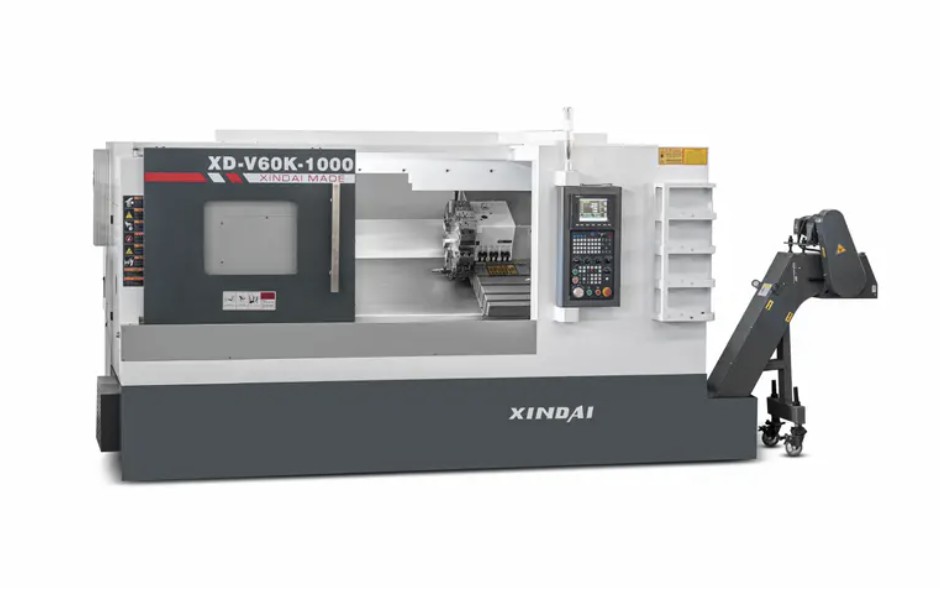
XD-V60K-1000 Long Bed Lathe with Turret and Tailstock
These nine elements are found on virtually every standard CNC turning center. They form the skeleton, muscle, and brain of the machine.
The machine bed is the foundation of the entire CNC lathe. Usually made from high-quality cast iron (often Meehanite) or a polymer composite, the bed supports every other component of the machine.
Its primary job is rigidity. When a cutting tool hits a spinning metal part, it creates significant vibration and heat. A heavy, well-damped bed absorbs these vibrations to prevent them from transferring to the cutting surface. If the bed isn’t rigid enough, you will see “chatter” marks on your finished parts, and maintaining tight tolerances will become a struggle. The bed also houses the guideways, ensuring that the carriage and tailstock move in a perfectly straight line relative to the spindle.
Located on the left side of the machine, the headstock is the powerhouse. It houses the main motor, the drive gears or belts, and the main spindle assembly.
The quality of the headstock determines the machine’s ability to handle heavy cuts. It needs to be robust enough to eliminate thermal distortion; as the machine runs and the motor heats up, a poorly designed headstock can shift slightly, causing “thermal drift” where part dimensions change over time. High-performance headstocks are often designed with cooling fins or liquid cooling systems to maintain temperature stability.
If the controller is the brain, the spindle is the heart. The main spindle is the rotating axis that delivers torque to the workpiece.
The spindle assembly consists of the shaft, bearings, and drive system (either belt-driven for vibration dampening or direct-drive for higher speeds and better surface finishes). Two factors matter most here: speed (RPM) and power (torque). High RPM is necessary for small diameter parts and finishing cuts, while high torque is required for large diameters and tough materials like stainless steel or titanium. The rigidity of the spindle bearings also dictates how round your parts will be.
The chuck is the clamp attached to the spindle face. Its job is simple but critical: grip the part securely while spinning at thousands of RPM.
There are different types of workholding for different applications:
3-Jaw Hydraulic Chuck: The most common standard. It’s versatile and great for holding round stock.
4-Jaw Chuck: Used for holding square or irregular shapes.
Collet Chuck: Uses a sleeve to grip the bar stock around its entire circumference. These are better for high-speed machining of smaller diameter bars because they have less mass and offer better concentricity.
Guideways are the tracks that the tool turret and tailstock slide along. They determine the accuracy of the machine’s movement.
You will typically encounter two types: Box ways and Linear guide ways. Box ways are heavy, rectangular tracks that offer immense rigidity and are ideal for heavy-duty cutting. Linear guide ways use ball bearings to slide, offering faster movement and higher precision for high-speed, light-duty machining. Both types must be perfectly aligned to ensure the tool moves exactly where the code tells it to.
Located opposite the headstock, the tailstock is a movable support unit. It is essential when machining long, slender parts (like shafts) that would otherwise bend or “whip” away from the cutting tool due to pressure.
The tailstock holds a “center” (a cone-shaped tool) that engages with the end of the workpiece to keep it spinning true. Additionally, the tailstock can hold a drill chuck to perform drilling operations directly into the center of the part.
The tool turret is the rotating block that holds your cutting tools. Instead of manually changing tools like on an old manual lathe, the CNC turret indexes (rotates) automatically to bring the correct cutter into position.
Turrets typically hold 8, 10, or 12 tool stations. The speed at which a turret indexes (measured in seconds) impacts your overall cycle time. A rigid turret is also crucial; if the turret flexes under load, the tool tip will move, and your part dimensions will drift.
This is the interface where the operator interacts with the machine. The CNC controller reads the G-code program and translates it into electrical signals that drive the axis motors and spindle.
Modern controllers are sophisticated computers. They allow operators to simulate the machining process before cutting metal, preventing crashes. They also monitor machine load, spindle temperature, and tool life. Common controller brands include Fanuc, Siemens, Haas, and Mitsubishi.
Machining generates immense heat. The coolant system pumps cutting fluid onto the tool and workpiece.
This serves three functions:
Lubrication: Reduces friction between the tool and the metal.
Cooling: Prevents the tool from overheating and breaking, and keeps the workpiece from thermally expanding.
Chip Evacuation: The pressure of the fluid flushes metal chips away from the cutting zone so they don’t get re-cut, which can damage the surface finish.
Once you move beyond simple turning, you encounter components that allow for “done-in-one” manufacturing—finishing a complex part in a single setup.
A sub-spindle sits in place of the tailstock. It is a fully functional second spindle that can move up and grab the part from the main spindle while it is still spinning (a “hand-off”).
This allows the machine to cut the front side of the part on the main spindle, hand it off to the sub-spindle, and then machine the back side. This eliminates the need for an operator to manually flip the part, drastically reducing cycle time and error.
Standard lathes only turn the part. A lathe with Live Tooling has a turret that can spin small milling cutters or drills.
To use these, you need a C-axis, which allows the main spindle to stop and index to precise angles (rather than just spinning continuously). This combination lets you mill flat surfaces, drill off-center holes, and tap threads into the side of a part, effectively combining a lathe and a mill into one machine.
Standard lathes move in two axes: X (diameter) and Z (length). A Y-axis adds vertical movement to the turret.
While a C-axis allows for some milling, a Y-axis is required for machining features that are truly flat or for drilling holes that are off-center but parallel to the main axis. It opens up the ability to machine complex geometries like keyways and pockets with much higher precision.
These components don’t cut the metal, but they make the process more profitable by reducing human intervention.
As the lathe cuts, it produces volume after volume of sharp metal chips. A chip conveyor is a belt system at the bottom of the machine that automatically carries these chips out and dumps them into a bin. For high-production runs, this is essential; otherwise, the machine would fill up with chips in an hour, requiring a shutdown for cleaning.
A bar feeder sits outside the machine and holds long bars of raw material (usually 6 or 12 feet long). It pushes the bar through the spindle tube into the chuck. As each part is finished and cut off, the feeder pushes more bar stock in. This allows the machine to run unattended for hours, often referred to as “lights-out manufacturing.”
If you have a bar feeder pushing parts in, you need a way to get finished parts out. A part catcher is a robotic arm or chute that extends when the part is cut off. It catches the finished piece and deposits it into a bin or onto a conveyor belt, preventing the part from falling into the pile of sharp chips at the bottom of the machine.
The machine bed and guideways are the most critical for accuracy. A rigid, heavy bed dampens vibrations, while precision-ground guideways ensure the tool travels in a perfectly straight line. If these foundational components are weak or worn, no amount of computer compensation can fix the resulting errors.
The headstock is the stationary casting or housing on the machine that holds the motor and transmission. The spindle is the rotating shaft inside the headstock that actually holds and spins the workpiece. Think of the headstock as the garage, and the spindle as the car inside it.
Use a 3-jaw chuck for standard round parts where quick setup is needed. Use a 4-jaw chuck for square parts or irregular shapes that need to be centered manually. Use a collet chuck for small-diameter bar stock where high speed and concentricity are required, as collets grip the material more evenly and have less mass than jaw chucks.
You need a tailstock when the length of your part is significantly greater than its diameter (typically a ratio of 3:1 or more). Without a tailstock, the pressure of the cutting tool will push the long part away, causing it to bend. This results in a part that is tapered (thicker in the middle) or causes chatter marks due to vibration.
The tool turret is the indexable block that holds your cutting tools. It affects cycle time based on how fast it can unlock, rotate, and lock the next tool into place. Stability is crucial; a turret that isn’t rigid will flex under heavy cutting loads, causing poor surface finishes and inaccurate dimensions.
A sub-spindle is a secondary spindle located opposite the main spindle. It enables “done-in-one” machining by grabbing the part from the main spindle to machine the back side. This eliminates the need for an operator to open the door, flip the part, and reload it, saving time and improving accuracy.
Live tooling refers to driven tools (like end mills or drills) mounted in the turret that can spin while the workpiece is stationary or rotating slowly. It unlocks operations usually reserved for milling machines, such as drilling cross-holes, milling flats (hexagons or squares), and tapping off-center threads.
For full automation, the bar feeder is the most critical as it supplies the raw material. However, it must be paired with a chip conveyor to remove waste and a part catcher to collect finished goods. Without all three working together, the machine cannot run unattended for long periods.
Understanding major CNC lathe components and functions makes it easier to evaluate machine capability, improve machining stability, and spot the real drivers of quality. While the controller gets a lot of attention, the mechanical reality of the machine is what dictates performance.
Quality starts with rigidity in the machine bed and guideways. It is maintained by the precision of the headstock, spindle, and chuck. It is supported by the tailstock, and executed by the tool turret. Finally, the entire process is orchestrated by the CNC controller and kept stable by the coolant system.
Once these core parts are clear, the path to higher profitability becomes obvious. Upgrades like sub-spindles, live tooling, and automation accessories aren’t just fancy add-ons; they are strategic investments that allow shops to produce more complex parts in less time. Whether you are troubleshooting a chatter issue or specifying a new machine purchase, knowing your components is the first step toward precision manufacturing.
Interested in learning more about the CNC machine solutions available from Xindai CNC? Contact our team to request detailed product information or technical support. You can reach us by email at dyxd1009@163.com, call our landline at +86-757-2610-6302 / +86-757-2837-9678, or speak directly with our sales team at +86-134-2066-3219.


