
English 
Address:
No, 309 Guandoumen Road, Wuhu Distict, China (Anhui) pilot Free Trade Zone


Views: 0 Author: Site Editor Publish Time: 2025-12-18 Origin: Site


In the world of modern manufacturing, few machines are as fundamental as the lathe. Often called the “mother of machine tools,” the lathe has been shaping cylindrical parts for centuries. But when you combine this ancient turning principle with Computer Numerical Control (CNC), you get a powerhouse of production that drives industries from automotive to medical technology. But what exactly is a CNC lathe machine? How does it differ from the manual lathes of the past, and why is it essential for creating everything from simple screws to complex engine shafts?
This comprehensive guide will break down the technology, history, and applications of CNC turning, helping you understand why this machine remains the backbone of precision manufacturing.
At its core, a CNC lathe machine is a manufacturing tool that rotates a workpiece while a cutting tool moves against it to remove material. This process is known as “turning.”To truly understand the machine, we need to break down the acronym “CNC.”
CNC stands for Computer Numerical Control. This means the machine is not operated by hand wheels and levers, but by a computer program (typically G-code). This digital brain dictates the exact speed, feed rate, and position of the tools, ensuring that every movement is calculated and precise.
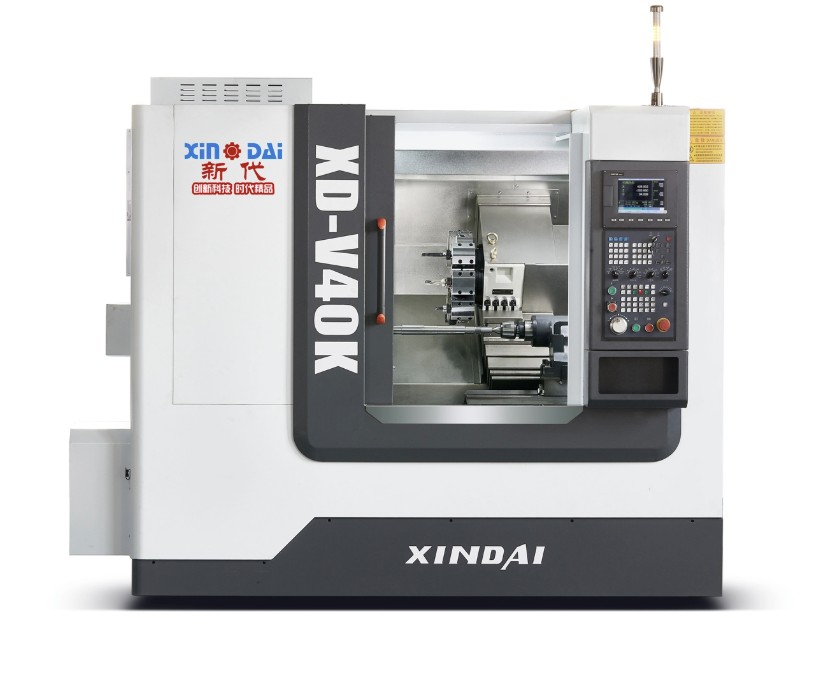
Servo Turret CNC Lathe with Hydraulic Tailstock
A traditional manual lathe requires a skilled machinist to manipulate the cutting tool by hand. The quality of the part depends entirely on the operator’s dexterity and focus.
A CNC lathe, however, automates this process. Once programmed, the machine executes the instructions with robotic consistency. This shift from manual control to computer control allows for mass production, complex geometries, and tolerances that human hands simply cannot replicate consistently.
Despite the high-tech controls, the physical principle remains simple:
Workpiece Rotation: The material (metal, plastic, or wood) is clamped into a chuck or collet and spun at high speeds.
Tool Movement: A stationary cutting tool moves along the X and Z axes to shave away material.
Because the workpiece spins while the tool stays (mostly) stationary, CNC lathes are specifically designed for creating round or axisymmetric parts. If you need a cylinder, a cone, or a sphere, the CNC lathe is the machine for the job.
In modern manufacturing, the CNC lathe is often the first machine a shop acquires. Why? because almost every mechanical assembly requires round parts—shafts, bolts, pins, and bushings. While milling machines handle flat and square surfaces, the CNC lathe dominates the world of rotation, making it an irreplaceable asset in the production chain.
The journey of the lathe from a hand-powered tool to a digital powerhouse is a fascinating timeline of industrial evolution.
For centuries, lathes were manual. The Industrial Revolution brought steam and then electric power to these machines, but they still relied on human guidance. As manufacturing demands grew for the automotive and aerospace sectors, the limitations of human speed and consistency became apparent. The industry needed a way to automate precision.
1940s – The Birth of NC: The concept didn’t start with computers, but with “Numerical Control” (NC). In the late 1940s, pioneers like John T. Parsons worked with the US Air Force to create helicopter blades that required complex curves. They used punched cards to guide machine tools—the precursor to modern code.
1950s – The Digital Shift: As computer technology emerged, NC evolved into CNC. The massive, room-sized computers of the 50s slowly shrank, becoming powerful enough to integrate directly into machine tools.
1970s and Beyond: The proliferation of microprocessors made CNC technology affordable and compact. This democratized precision manufacturing, allowing smaller shops to compete with industrial giants.
The technology didn’t stop at simple automation. It evolved in complexity:
From 2-Axis to Multi-Axis: Early CNC lathes moved only in X (diameter) and Z (length). Today, multi-axis machines can approach the part from all angles.
From Single Turning to Turning Centers: The modern machine is often called a “Turning Center” because it does more than just turn. It can drill, tap, and even mill, thanks to the integration of live tooling (powered rotating tools).
The impact of this transition was profound.
Precision: Machines could hold tolerances of +/- 0.0001 inches consistently.
Consistency: The thousandth part produced is identical to the first.
Mass Production: Factories could run “lights out” manufacturing, producing parts 24/7 with minimal human supervision.
Not all CNC lathes are created equal. Walking into a machine shop, you might see small, compact machines next to massive vertical turrets. How do we categorize them?
The most common way to classify these machines is by the number of axes. In machining, an “axis” represents a direction of motion. The more axes a machine has, the more complex geometry it can cut without having to remove the part and re-fixture it.
This is the standard, workhorse configuration.
X-Axis: Controls the cross-slide (diameter of the part).
Z-Axis: Controls the carriage travel (length of the part).
Capabilities: Perfect for standard OD (Outer Diameter) and ID (Inner Diameter) turning, facing, drilling, and tapping the center of the part.
Best For: Simple pins, shafts, and washers.
Addition: Adds a C-axis and a Live Tool system.
Capabilities: The C-axis allows the main spindle to position the part at specific angles (indexing) or rotate it slowly while a powered tool (live tool) drills or mills holes into the face or side of the part.
Best For: Parts requiring a keyway, a bolt-hole circle on the face, or simple side drilling.
Addition: Adds a Y-axis.
Capabilities: A standard 3-axis machine can only move the tool to the center. A Y-axis allows the tool to move up and down, perpendicular to the spindle. This enables off-center machining.
Best For: Machining flat surfaces on the side of a shaft or drilling holes that are not on the centerline.
Addition: Often adds a second turret (B-axis) to a 3-axis setup.
Capabilities: With two turrets working simultaneously, you can cut the cycle time in half. While the top turret turns the OD, the bottom turret can drill the ID.
Best For: High-volume production where speed is critical.
Addition: Includes a Sub-Spindle and potentially multiple turrets.
Capabilities: The main spindle machines the front of the part. Then, the sub-spindle moves in, grabs the part, and pulls it back to machine the rear side—all while the part is spinning.
Best For: “Done-in-One” manufacturing. You put a raw bar in, and a completely finished part comes out.
You will often hear these terms used interchangeably, but there is a nuance.
CNC Lathe: Usually refers to simpler 2-axis machines strictly used for turning operations.
Turning Center: Refers to machines equipped with advanced features like automatic tool changers, chip conveyors, and live tooling (drilling/milling capabilities).The concept of the Turning Center is “Done-in-One”—completing a part in a single setup to eliminate handling errors.
The orientation of the spindle matters significantly depending on what you are making.
Horizontal CNC Lathe: The spindle is horizontal. The tool approaches from the side.
Best For: Long, shaft-like parts or small-to-medium components. This is the most common type found in machine shops.
Vertical CNC Lathe (VTL): The spindle sits on the bottom, pointing up like a record player.
Best For: Heavy, large-diameter parts (like train wheels or jet engine rings).
Why? Gravity works with you. On a horizontal lathe, a heavy part might sag, causing inaccuracies. On a vertical lathe, the weight sits securely on the chuck table.
CNC lathes are versatile, but they aren’t the solution for every problem. Knowing what they excel at helps manufacturers maximize efficiency.
If the part is round, it belongs on a lathe. Common candidates include:
Shaft Parts: Drive shafts, axles, and camshafts.
Tubes and Sleeves: Hydraulic cylinders and bushings.
Cylindrical Parts: Pistons and rollers.
Threaded Parts: Screws, bolts, and custom fasteners.
While “turning” is the main event, a CNC lathe performs a suite of operations:
Turning (OD/ID): Removing material from the outside or inside to reduce diameter.
Facing: Cutting the end of the workpiece flat.
Grooving & Parting: Cutting narrow channels (for O-rings) or cutting the finished part off the raw bar stock.
Drilling / Boring: Creating holes in the center of the axis.
Tapping: Cutting threads inside a hole.
Milling: Using live tooling to cut flats or keyways.
It is difficult to find a sector that doesn’t rely on these machines.
Automotive: Pistons, engine blocks, and brake discs.
Aerospace: Landing gear components and turbine shafts.
Medical: Bone screws and titanium implants.
Oil & Gas: Drill bits and high-pressure valves.
Electronics: Tiny connectors and heat sinks.
It comes down to three factors:
High-precision OD/ID
Stable Batch Consistency
Complex Single-Op Production
Industries rely heavily on CNC lathes primarily because they deliver unmatched accuracy, consistency, and production efficiency for rotational parts. Many critical components-such as engine parts and hydraulic systems-depend on extremely precise outer and inner diameters to ensure proper sealing and performance, a level of roundness that only CNC turning can reliably achieve.
In high-volume sectors like automotive manufacturing, CNC lathes also guarantee stable batch consistency, where every part, such as a piston, must be virtually identical to maintain smooth and reliable operation.
Additionally, modern multi-axis CNC lathes enable complex single-operation production, allowing manufacturers in industries like aerospace to complete intricate components in one setup. This eliminates multiple machine transfers, significantly reducing cumulative errors while improving overall productivity and part quality.
Here are answers to some of the most common questions regarding CNC turning technology.
The primary difference lies in what moves. In a CNC Lathe, the workpiece rotates and the tool is stationary. This is ideal for round parts. In a CNC Mill, the tool rotates and the workpiece is stationary. Mills are better suited for square, flat, or boxy parts.
Any part that has an axis of symmetry is perfect for turning. Think of items like baseball bats, chess pawns, screws, bolts, shafts, and washers. If the cross-section is a circle, it is a turning job.
OD stands for Outer Diameter, referring to machining the external surface of the cylinder. ID stands for Inner Diameter, referring to machining the inside of a hole or tube (boring).
For general machine shops, a 2-axis lathe covers about 60-70% of standard work. However, if you are a job shop handling complex contracts, a 3-axis or 4-axis machine (with Y-axis and live tooling) is often necessary to stay competitive and reduce setup times.
Live tooling refers to cutting tools in the lathe turret that are powered and can spin (like a drill bit or end mill). It is needed when you must perform milling operations—like drilling a hole on the side of a shaft or cutting a flat square on the end of a round bar—without moving the part to a milling machine.
While the terms are often swapped, a Turning Center generally implies a higher level of capability. It usually features a full enclosure, chip conveyor, and live tooling, whereas a “CNC Lathe” might refer to a simpler, 2-axis open-bed machine. Turning Centers are designed for high-production environments.
Yes, but it typically requires a multi-axis machine. A machine with a Sub-Spindle can machine the front of the part, transfer it to the second spindle to machine the back, and eject a finished component without the operator ever touching it.
The Medical and Aerospace industries benefit most. The parts they require (like spinal implants or turbine blades) often have complex, organic geometries that require simultaneous movement of 5 or more axes to machine accurately.
The CNC lathe machine has evolved from a simple mechanical tool into a sophisticated digital manufacturing center. By combining the rotational physics of turning with the computational power of CNC, manufacturers can produce round parts with speed, accuracy, and complexity that were unimaginable just a few decades ago.
From the basic 2-axis models that churn out simple bolts to the advanced multi-axis Turning Centers that produce life-saving medical implants in a single operation, the CNC lathe remains the backbone of the industry. Understanding its capabilities is the first step toward mastering modern manufacturing.
CNC lathe machines remain the foundation of precision turning and round-part manufacturing across global industries.
Interested in learning more about the CNC machine solutions available from Xindai CNC? Contact our team to request detailed product information or technical support. You can reach us by email at dyxd1009@163.com, call our landline at +86-757-2610-6302 / +86-757-2837-9678, or speak directly with our sales team at +86-134-2066-3219.


