
English 
Address:
No, 309 Guandoumen Road, Wuhu Distict, China (Anhui) pilot Free Trade Zone


Views: 0 Author: Site Editor Publish Time: 2026-01-20 Origin: Site


Traditional 3-axis machining often hits a hard wall when facing modern design demands. Engineers today require tight tolerances and organic shapes that standard equipment simply cannot produce efficiently. This bottleneck creates production delays, increases scrap rates, and forces manufacturers to compromise on design integrity. To overcome these limitations, the industry has evolved toward multi-axis machining. This is not merely an upgrade in technology; it is a strategic consolidation strategy that significantly reduces manufacturing risk and lead time.
The purpose of this article is to move beyond basic feature lists. We will analyze the commercial and technical ROI of upgrading your production to 4-axis, 5-axis, or 9-axis turn-mill services. Our scope covers the reality of simultaneous capabilities, true cost-per-part calculations, and the quality implications for high-stakes industries like medical devices and aerospace. You will learn why paying a higher hourly machine rate can paradoxically lower your total project costs.
Single-Setup Integrity: How reducing fixtures correlates directly to "Relational Accuracy."
Simultaneous vs. 3+2: Understanding the difference between positioning and continuous contouring.
Hidden Cost Reduction: Why higher hourly machine rates often result in lower Total Cost of Ownership (TCO).
Design Freedom: Removing manufacturing constraints for complex, organic geometries.
Surface Quality: How shorter tool extensions improve finishes and reduce secondary operations.
One of the silent killers of precision in manufacturing is the accumulation of error, often referred to as "stacking error." In a traditional 3-axis workflow, machining a complex part often requires operators to manually flip and re-fixture the workpiece multiple times to access different sides. Every time a human operator unclamps a part and reclamps it in a new fixture, a small margin of error is introduced. Even with skilled technicians, chip debris or slight misalignment can shift the "zero point" (datum) by microns.
When these small errors occur across three or four setups, they stack up. The relationship between a hole on Side A and a flange on Side B may drift out of tolerance, leading to parts that look correct individually but fail during assembly.
Multi-axis technology solves this fundamental physics problem by maintaining a single datum for the entire process. Once the raw material is clamped into a 5-axis or multi-spindle machine, the cutting tools can access five or more sides of the workpiece without the operator ever touching it. This ensures that every feature is machined relative to the exact same zero point.
This capability achieves superior "Relational Accuracy." This is the precision of features relative to one another, rather than just their absolute position in space. For tight-tolerance assemblies, such as optical housings or aerospace valves, relational accuracy is non-negotiable. By keeping the part stationary relative to the chuck, we naturally improve machining accuracy and ensure that the final component matches the digital CAD model perfectly.
For decision-makers, the impact is clear. Eliminating re-fixturing dramatically lowers the risk of non-conformance. You avoid the catastrophic failure scenarios where misalignment prevents components from mating correctly in the final assembly.
A common point of confusion for buyers is the difference between "3+2" machining and true simultaneous machining. Understanding this distinction is vital for determining whether a shop can actually produce your design.
Positional machining, often called 3+2, involves using the rotary axes to tilt the part to a fixed angle, locking it in place, and then using the standard linear axes (X, Y, Z) to cut. This is excellent for drilling holes on angled surfaces but insufficient for complex curves. In contrast, 5-axis simultaneous machining involves the X, Y, Z, A, and B axes moving together in a choreographed dance. The tool stays in constant engagement with the workpiece while the angles change dynamically.
This continuous movement allows the cutting tool to navigate around the part to create organic shapes. It is the only way to machine components like impellers, turbine blades, and anatomical medical implants where smooth, flowing surfaces are required.
Standard 3-axis machines operate in a straight line from top to bottom. They cannot reach "under" a ledge or machine a feature that is tucked away behind another wall. Multi-axis machines can tilt the tool or the table to access these "undercuts." This capability allows engineers to design parts with fewer compromises. You no longer need to split a complex manifold into two separate blocks just to make the internal channels accessible.
Furthermore, advanced turning centers equipped with substantial Y-axis travel and tilting milling heads can perform complex off-center operations. They can mill flat surfaces, drill cross-holes, and machine pockets on a cylindrical part without ever moving it to a separate milling machine.
These capabilities find specific relevance in high-tech sectors. In the manufacturing of medical equipment, such as bone screws and anatomical plates, the geometry must match the organic curvature of the human body. Similarly, in robotics, articulated joints often require complex housing shapes to maximize range of motion while minimizing weight. Multi-axis machining makes these designs manufacturable at scale.
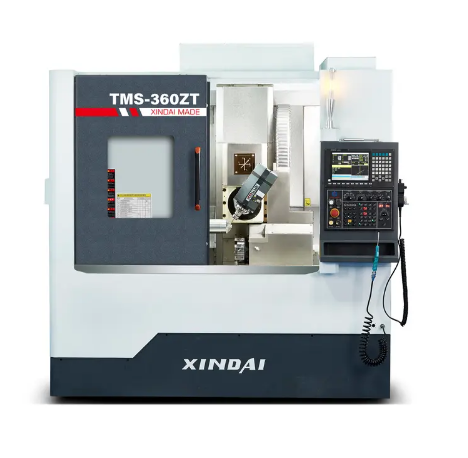
There is a widespread misconception that multi-axis machines are always faster at cutting chips. In reality, the cycle time for a specific cut might be similar to a 3-axis machine. However, the metric that matters to your supply chain is "Total Production Time" or "Door-to-Door Time." This is where setup consolidation changes the game.
Consider a complex aluminum housing. On a 3-axis process, this part might require:
Setup 1: Machine top face (30 mins cut + 45 mins setup).
Wait time: Part sits in a bin waiting for the next machine.
Setup 2: Machine right side (15 mins cut + 30 mins setup).
Setup 3: Machine left side (15 mins cut + 30 mins setup).
The total time involves hours of non-value-added waiting and calibration. With a multi-axis strategy, we reduce setup requirements to a single event. The operator sets the part once, and the machine completes all operations in a continuous sequence. Even if the actual cutting time is 60 minutes, the elimination of intermediate setups and wait times slashes the total lead time by days or weeks.
This consolidation increases throughput velocity, which is critical for high-mix, low-volume orders. Instead of having batches of Work-In-Progress (WIP) inventory sitting on the shop floor waiting for a second or third operation, raw material enters the machine and leaves as a finished part. This "Done-in-One" philosophy streamlines logistics and allows manufacturers to respond faster to urgent market demands.
Surface finish is not just about aesthetics; it is often a functional requirement for sealing surfaces and friction reduction. Multi-axis machining offers a distinct physical advantage in achieving superior finishes due to tool rigidity.
In 3-axis machining, reaching the bottom of a deep cavity requires a long cutting tool. Physics dictates that the longer a tool extends from the holder, the more it will vibrate (chatter) during cutting. This vibration leaves unsightly marks on the surface and reduces dimensional accuracy.
Multi-axis machines can tilt the workpiece or the spindle head. This allows the tool holder to get closer to the cutting area, enabling the use of much shorter, more rigid cutting tools. Shorter tools are stiffer and vibrate significantly less. The result is a smoother surface finish immediately off the machine, often eliminating the need for manual polishing.
| Feature | 3-Axis Strategy | Multi-Axis Strategy |
|---|---|---|
| Tool Length | Long reach required for deep features | Short, rigid tools via tilting |
| Vibration (Chatter) | High risk, reduced speed | Minimal, higher stability |
| Cutting Point | Often uses tool tip (zero velocity) | Uses tool side (tangential) |
| Surface Result | Often requires benchwork | Premium "off-machine" finish |
Using a ball-nose end mill on a 3-axis machine forces the tip of the tool—where the rotation speed is effectively zero—to drag across the material. This produces poor finishes and wears out the tool quickly. Multi-axis strategies use "tangential cutting." By tilting the tool, the machine utilizes the side of the cutter (the periphery) where the cutting speed is optimal. This prevents heat buildup and dramatically extends tool life. This is particularly beneficial when machining difficult materials like titanium or reinforced plastics, where thermal stress can compromise the part's integrity.
Procurement teams often look at a quote and see that the hourly rate for a 5-axis machine is significantly higher than a vertical 3-axis mill. They assume the 5-axis option is too expensive. This is the "Hourly Rate Fallacy." To understand the true cost, one must look at the Total Cost of Ownership (TCO).
The cost-per-part is often lower on multi-axis equipment due to several efficiency gains that offset the hourly rate:
Labor Savings: One operator can run one sophisticated machine, rather than having personnel moving parts between three different machines. Labor is typically the highest cost in manufacturing; reducing touch-time reduces cost.
Scrap Reduction: High-value materials like Inconel or Titanium are expensive to scrap. By eliminating the human error associated with re-fixturing, the yield rate improves. A 99% yield on a 5-axis machine is cheaper than an 85% yield on cheap 3-axis machines when the raw material costs $500 per block.
Fixture Savings: Traditional machining often requires custom jigs and fixtures for every angle of the part. Designing, machining, and storing these fixtures costs money. Multi-axis machining uses standard work-holding to access almost all faces, eliminating these hidden tooling costs.
For parts with complex geometry, the efficiency gains in setup, labor, and quality assurance typically result in a lower final invoice price, despite the higher machine hourly rate.
Not every part requires the sophistication of multi-axis technology. It is important to match the manufacturing process to the design requirements to avoid over-spending.
We recommend sticking to traditional 3-axis machining for simple prismatic parts. If your component is a square block, a bracket, or a plate with features located on only one or two parallel faces, 3-axis is the most improved economic choice. Additionally, for high-volume production runs with loose tolerances where setup costs can be amortized over thousands of units, the speed of simple linear machines is hard to beat.
You should switch to multi-axis services when the part requires machining on four or more faces. It is also the correct choice for features requiring tight relational tolerances where stacking error is unacceptable. Furthermore, consider this route for materials that are sensitive to handling; minimizing the number of times a part is clamped and unclamped reduces the risk of scratching or deforming delicate surfaces.
Strategic Sourcing Tip: Look for machine shops that offer both capabilities. A shop with a diverse fleet won't force a simple part onto an expensive 5-axis machine just to fill capacity, nor will they attempt to hack a complex aerospace part on a basic mill.
Multi-axis machining represents more than just a capability upgrade; it is a shift toward process security, speed, and verifiable accuracy. While the initial hourly rates may appear higher, the reduction in labor, fixtures, and risk often makes it the most cost-effective solution for modern components. For industries like medical and aerospace, the "risk cost" of sticking to disjointed 3-axis processes often far outweighs any potential savings.
We encourage engineers and procurement managers to audit their current designs for "manufacturability." Consult with a precision shop early in the design phase to simulate the multi-axis advantage. By optimizing your parts for these advanced workflows, you can unlock higher quality and faster delivery times.
A: The primary difference lies in movement. In 3+2 machining, the machine tilts the tool to a fixed angle and locks it there before cutting (positional). In simultaneous 5-axis machining, all axes (X, Y, Z, A, B) move continuously at the same time. This allows the tool to follow complex, organic contours and curves that positional machining cannot produce.
A: Not necessarily. While the machine's hourly rate is higher, the total part cost is often lower for complex designs. This is because multi-axis machining reduces labor costs, eliminates the need for multiple expensive fixtures, and significantly reduces scrap rates caused by manual handling errors.
A: It improves accuracy by machining all sides of a part in a single setup (Single Datum). In traditional machining, moving a part between machines introduces "stacking errors" with every new setup. Multi-axis machines eliminate this re-fixturing, ensuring superior relational accuracy between features.
A: All standard materials work well, but the technology offers high value for expensive alloys like Titanium and Inconel by reducing the risk of scrap. It is also excellent for softer plastics, as fewer manual setups mean less chance of scratching or deforming the part during handling.


