
English 
Address:
No, 309 Guandoumen Road, Wuhu Distict, China (Anhui) pilot Free Trade Zone


Views: 0 Author: Site Editor Publish Time: 2026-04-02 Origin: Site


The days of purchasing a "general-purpose" CNC lathe and hoping it fits all future needs are fading. Modern machining demands a shift toward application-specific procurement, where every specification is scrutinized for its impact on performance and profitability. Choosing the right machine is a high-stakes decision. Over-specifying leads to unnecessary capital expenditure and a higher cost per part, while under-specifying creates operational bottlenecks, quality issues, and missed opportunities. This guide provides a technical framework for evaluating CNC turning center technical specifications. Our objective is to empower you to select a machine that not only meets your current demands but also delivers a strong return on investment and consistent part quality for years to come.
Dimensional Limits: Distinguish between "Swing Over Bed" and "Max Turning Diameter" to avoid tool interference.
Power Dynamics: Balance high torque for heavy-duty cutting with high RPM for small-diameter precision.
Complexity Matching: Determine when a CNC turning-milling compound lathe with power turret is required over a standard 2-axis setup.
Industry Precision: Specialized requirements for a CNC lathe for medical parts (micromachining, surface finish, and exotic material handling).
Operational TCO: Factor in control system consistency and MTBF (Mean Time Between Failures) over initial sticker price.
The first step in evaluating any CNC lathe is understanding its physical limitations. These specifications define the size and shape of parts you can produce. However, spec sheets can be misleading if you don't grasp the nuances behind the numbers.
These two terms are often confused, leading to costly purchasing mistakes. "Maximum swing" refers to the largest diameter workpiece that can rotate in the spindle without hitting the machine's bed or way covers. It's a clearance measurement. In contrast, "maximum turning diameter" is the largest diameter a cutting tool can practically machine. This dimension is always smaller than the swing because it accounts for the space taken up by the turret, tool holders, and the tool itself. This is the "interference zone." Always base your decision on the maximum turning diameter required for your parts, not the swing.
This specification indicates the longest part you can machine between the chuck and a tailstock. It is primarily determined by the machine's Z-axis travel. When evaluating this, consider not just the finished part length but also the space needed for tool approach, retraction, and the physical body of the tailstock. A machine with 500 mm of Z-axis travel may not be able to turn a 500 mm long part if the tailstock quill and tooling interfere.
The spindle bore is the through-hole in the center of the spindle and chuck. Its diameter dictates the maximum bar stock size you can feed through for high-volume production using a bar feeder. If your work primarily involves chucking individual billets or castings, a smaller spindle bore may be acceptable. However, for shops aiming to automate with bar feeding, the bar capacity is a critical bottleneck. Ensure it comfortably exceeds the largest diameter stock you plan to run.
The machine's physical footprint is an obvious consideration for shop floor layout. But you must also account for the "real-world" space it needs to operate efficiently. Consider the full swing of the machine doors, the space required for chip conveyor maintenance, and access for service technicians. A compact machine squeezed into a tight corner can become a maintenance and operational headache, negating its space-saving benefits.
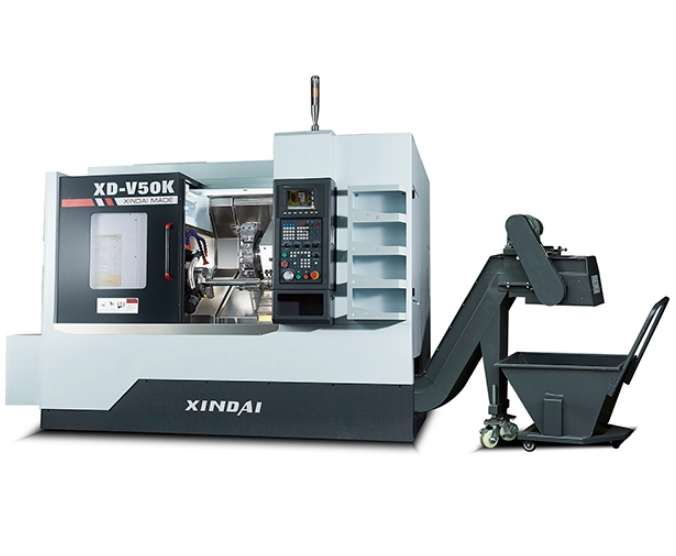
The spindle is the heart of a CNC turning center. Its power, speed, and stability directly influence cycle times, surface finish, and the types of materials you can effectively machine.
High horsepower (HP) is often used as a primary marketing metric, but it doesn't tell the whole story. Torque is the rotational force the spindle can deliver, which is crucial for heavy-duty cutting in tough alloys like Inconel or stainless steel. A high-HP spindle that only achieves its peak power at maximum RPM might struggle with low-speed, high-torque operations like large-diameter drilling or heavy roughing cuts. This is where the spindle drive type matters.
Geared Headstocks: These use a transmission to deliver high torque at low RPMs, making them ideal for heavy metal removal.
Built-in or Direct-Drive Motors: These offer faster acceleration and higher top speeds, excelling in high-volume production of smaller parts from aluminum or brass.
Constant Surface Speed is a control feature that automatically adjusts the spindle RPM as the tool moves toward or away from the center of the workpiece. As the turning diameter decreases, the RPM increases to maintain a constant "surface feet per minute" (SFM) or "meters per minute" at the cutting edge. Using CSS is a best practice that significantly improves tool life and produces a consistent surface finish across the entire face of a part.
This is a "hidden" specification that dramatically impacts cycle times, especially in high-volume production with frequent starts, stops, and direction changes. A spindle that can accelerate and decelerate rapidly shaves seconds off operations like threading, tapping, and pecking cycles. Over thousands of parts, this saved time translates directly into higher profitability.
For consistent, high-precision machining, the spindle must be both rigid and thermally stable. High-quality machines use precision-grade angular contact bearings (e.g., P4 or P2 class) to handle both radial and axial loads. As the spindle runs for hours, it generates heat, which can cause thermal growth and affect machining accuracy. Look for specifications that detail the spindle cooling system, such as a chilled oil circulation system. This feature is non-negotiable for shops running tight-tolerance parts in a 24/7 environment.
A lathe's ability to produce complex parts efficiently is determined by its turret and tooling capabilities. Modern turning centers have evolved far beyond simple two-axis machines.
A standard static turret holds fixed turning and boring tools. To perform any milling or drilling operations, the part must be moved to a separate machine. A power turret, also known as a live-tooling turret, has stations that can drive rotating tools like end mills and drills. Investing in a CNC turning-milling compound lathe with power turret enables "done-in-one" processing. It eliminates secondary operations, reduces setup time, and improves accuracy by machining multiple features in a single clamping.
If you opt for a power turret, you must examine its specifications closely. Key metrics include:
RPM Limits: Can the live tools spin fast enough for efficient milling with small-diameter cutters?
Torque Ratings: Is there enough power for drilling or tapping in tough materials?
Y-axis Travel: The addition of a Y-axis allows for true off-center milling, drilling, and engraving. Without it, live tooling is limited to operations on the part's centerline or face.
Chip-to-chip time measures the total time from when one tool finishes cutting to when the next tool begins cutting. This includes turret indexing, rapid traverse moves, and any other non-productive motion. For parts with many different tools and short cycle times, a fast chip-to-chip time is a major driver of profitability. A difference of even one or two seconds can add up to significant production gains over a year.
A sub-spindle is a secondary, opposing spindle that can grip the back end of a part. This allows the machine to transfer the workpiece from the main spindle to the sub-spindle and perform machining operations on the "back" side of the part. This capability completely eliminates the need for a second operation to finish the part, drastically reducing labor, handling, and potential for error. The synchronization between the main and sub-spindle must be precise to ensure a seamless transfer without damaging the part.
Different industries impose unique demands on CNC turning centers. The specifications required for a general job shop are often insufficient for high-stakes sectors like medical and aerospace manufacturing.
The manufacturing of medical devices, such as surgical implants and instruments, is defined by micromachining, tight tolerances, and exotic materials.
High-Speed Spindles: A CNC Lathe for Medical Parts often requires spindle speeds of 10,000 RPM or higher. This is necessary for efficient machining of small-diameter components made from titanium, PEEK, and 316L stainless steel using tiny cutting tools.
Precision Requirements: Repeatability is paramount. For components like bone screws or spinal implants, a machine must consistently hold tolerances within ±0.002 mm (2 microns). This level of precision depends on the machine's build quality, thermal stability, and control resolution.
Swiss-type vs. Fixed Headstock: For long, slender parts (high length-to-diameter ratio), a Swiss-type lathe is often superior. It supports the workpiece with a guide bushing right at the point of cutting, minimizing deflection and vibration. For shorter, more robust parts, a traditional fixed headstock machine is sufficient.
In both medical and aerospace, surface finish is a critical functional requirement, not just an aesthetic one. Achieving sub-micron Ra (Roughness average) values requires a machine with exceptional rigidity and vibration-dampening characteristics. The bed material plays a huge role here. Cast iron has long been the standard for its excellent vibration absorption. However, some high-end machines now use mineral composite or polymer concrete bases, which can offer even greater damping properties, leading to superior surface finishes and longer tool life.
| Feature | Cast Iron Bed | Mineral Casting Bed |
|---|---|---|
| Vibration Damping | Good | Excellent (6-10x better than cast iron) |
| Thermal Stability | Moderate | High (less reactive to temperature changes) |
| Cost | Standard | Higher |
| Best For | General purpose, heavy roughing | High-precision finishing, hard turning |
The spec sheet only tells part of the story. Long-term success with a CNC machine depends on factors that influence its daily operation, serviceability, and total cost of ownership (TCO).
Sticking with a consistent brand for your CNC controls (e.g., Fanuc, Siemens, Heidenhain) across the shop floor offers a significant strategic advantage. Operators can move between machines without extensive retraining, and maintenance teams become more efficient by specializing in a single system. This brand consistency also simplifies sourcing spare parts and finding qualified service technicians.
For high-mix, low-volume job shops or prototyping, the ability to program simple parts directly at the machine is invaluable. Conversational control systems (like Mazak's Mazatrol or Haas's VPS) use graphical prompts to guide the user through creating a program without writing G-code manually. While complex 3D toolpaths will always require a CAM system, conversational programming can drastically reduce setup time for simpler jobs.
Before purchasing, assess the manufacturer's approach to service and support. Look for deep, comprehensive documentation, including electrical schematics and mechanical diagrams. Investigate the machine's Mean Time Between Failures (MTBF) data if available. A manufacturer that embraces the "right to repair" by providing access to parts and information empowers your in-house team to handle routine maintenance, reducing downtime and service costs. Also, confirm the availability of local, factory-trained service support for more complex issues.
Your needs may change over the next 5-10 years. A machine that is "automation-ready" from the factory can save significant retrofitting costs later. This includes pre-wiring and integrated interfaces for common peripherals like automatic bar feeders, parts catchers, and robotic loading/unloading systems. Future-proofing your investment ensures the machine can scale with your business growth.
To synthesize this information, use the following checklist to evaluate potential CNC turning centers against your specific needs.
Geometry & Material Match: Does the spindle torque curve align with the materials you cut most often? If you machine tough alloys, you need high torque at low-to-mid RPMs. If you machine aluminum, high RPM is more critical.
Tolerance vs. Machine Grade: Do your part tolerances justify the cost of a high-precision machine? Match the required positioning accuracy (e.g., ±0.005 mm) and repeatability (e.g., ±0.002 mm) to the machine's capabilities. Don't pay for precision you don't need.
Volume vs. Automation: Is the machine configured for your typical batch sizes? For high volume, a fast turret, spindle bore for bar feeding, and sub-spindle are key. For jobbing work, ease of setup and conversational programming might be more important.
Operational Environment: Have you confirmed your facility's power supply (three-phase is standard for industrial machines)? For specific applications like deep-hole drilling in stainless steel, does the machine support high-pressure coolant (70-bar or 1000-PSI systems)?
Scalability: Does the machine's configuration allow for future growth? Choosing a machine with C-axis and Y-axis capability, even if not immediately needed, provides a path to take on more complex and profitable work without buying a new machine.
Selecting the right CNC lathe is a process of meticulously matching technical specifications to your unique business outcomes. It requires moving beyond simple metrics like horsepower and footprint to analyze the dynamic interplay between spindle performance, tooling capacity, and control features. The most effective strategy is to define your parts, materials, and production goals first, then use that data to filter your machine options.
Before making a final decision, always request a "test cut" on one of your challenging parts using your specified material. This real-world demonstration provides the ultimate proof of a machine's capability. Remember, a CNC lathe is not just a tool; it is a 10 to 15-year investment in your shop's capacity, efficiency, and competitive edge.
A: While often used interchangeably, a "CNC lathe" typically refers to a simpler 2-axis machine for basic turning operations. A "CNC turning center" is a more advanced machine that usually includes an automatic tool changer (turret), an enclosure for coolant management, and often has additional capabilities like live tooling, a sub-spindle, or a Y-axis.
A: For most general job shop applications, a machine with a positioning accuracy of ±0.010 mm (0.0004") and a repeatability of ±0.005 mm (0.0002") is sufficient. Tighter tolerances for industries like aerospace or medical may require machines with significantly higher precision, which come at a premium cost.
A: A vertical lathe is ideal for large, heavy, and short workpieces, such as flanges, gears, or rings. Gravity helps seat the part securely in the chuck, making loading easier and improving stability. Horizontal lathes are more common and are better suited for longer, shaft-type work, especially when using a bar feeder or tailstock.
A: A sub-spindle is worth the investment if you frequently produce parts that require machining on both ends. It enables "done-in-one" manufacturing, which eliminates costly secondary operations, reduces part handling, shortens lead times, and improves overall accuracy by avoiding re-chucking errors.
A: Nearly all industrial-grade CNC lathes require a three-phase power supply, typically at 208-240V or 480V in North America. Smaller, benchtop or "garage-friendly" models might run on single-phase power, but they lack the rigidity and power for serious production work. Always verify your building's power service before purchasing.


