
English 
Address:
No, 309 Guandoumen Road, Wuhu Distict, China (Anhui) pilot Free Trade Zone


Views: 0 Author: Site Editor Publish Time: 2026-03-30 Origin: Site


The era of treating CNC turning centers as interchangeable commodity hardware is over. In today's competitive landscape, "standard" specifications are rarely sufficient to unlock maximum efficiency. Shops now demand precision-engineered solutions tailored to specific materials, geometries, and production volumes. This shift places immense pressure on buyers to make the right choice. The financial penalty for getting it wrong is severe; over-specifying a machine ties up capital in unused capabilities, while under-specifying creates production bottlenecks that cripple throughput and profitability. This guide provides a strategic framework for evaluating CNC turning center technical specifications, moving beyond the brochure to align your investment directly with measurable ROI and production goals.
Part-Centric Selection: Machine specs must be dictated by the most complex part in your current or projected portfolio.
Beyond Horsepower: Torque curves and spindle acceleration often matter more than peak HP for cycle time optimization.
The "Done-in-One" Advantage: How multi-axis and compound lathes reduce TCO by eliminating secondary operations.
Precision vs. Rigidity: The critical trade-off between linear guides (speed) and box ways (heavy-duty damping).
The first step in selecting the right CNC turning center is to move past surface-level specifications and define your true operational envelope. A machine's datasheet is a starting point, not the final word. To avoid costly purchasing errors, you must translate these numbers into the practical realities of your workshop floor.
Capacity is the most fundamental specification, but it's often misunderstood. Two key terms create frequent confusion:
Swing Over Bed: This measures the largest diameter workpiece that can rotate over the machine's ways without interference. It represents the absolute maximum clearance.
Maximum Turning Diameter: This is the more practical figure. It defines the largest diameter you can actually machine, considering the travel limits of the turret and cross-slide. This number is always smaller than the swing over bed.
What to watch out for: Always prioritize the maximum turning diameter. A large swing over bed is useless if the tool turret cannot reach the workpiece's outer edge. Misinterpreting this can lead to purchasing a machine that physically fits your part but cannot machine it.
Distance Between Centers (DBC) dictates the maximum length of a workpiece that can be mounted between the main spindle chuck and a tailstock. However, the listed DBC is a theoretical maximum. In practice, the length of the chuck jaws and the tailstock quill extension reduce this usable length. For long, slender parts, this specification is critical to ensure proper support and prevent chatter or deflection.
For shops focused on high-volume production, bar capacity is a non-negotiable metric. This specification defines the maximum diameter of bar stock that can pass through the spindle bore. It is the gateway to automated production using a bar feeder, which dramatically reduces manual loading times and enables "lights-out" manufacturing. If your business model relies on producing thousands of identical parts from bar stock, this limit directly impacts your profitability.
The ultimate goal is to define your "envelope of work." This involves analyzing your most challenging and most common jobs. Identify the parts with the largest diameter, the longest length, and the required bar size. A common mistake is to purchase a machine that handles 80% of your jobs perfectly but is too small for the other 20%. This forces you to outsource high-value work or decline profitable contracts. A well-defined work envelope ensures your new asset can handle not just today's jobs, but also the more complex work you plan to win tomorrow.
Once you have confirmed a machine's physical capacity, the next step is to scrutinize its performance characteristics. The spindle is the heart of any turning center, and its capabilities directly influence cycle times, surface finish, and the types of materials you can effectively machine.
Peak horsepower and RPM are important, but they don't tell the whole story. Two other factors are crucial for performance:
Constant Surface Speed (CSS): A quality CNC controller can maintain a consistent cutting speed (measured in SFM or m/min) by automatically adjusting the spindle RPM as the tool moves toward or away from the center of the part. This is essential for achieving a uniform surface finish across a faced part.
Spindle Ramp-Up/Down Times: In jobs with frequent starts, stops, and tool changes (like drilling multiple holes), the time it takes for the spindle to accelerate to speed and decelerate to zero can add significant, non-productive time to your cycle. A machine with faster acceleration can shave valuable seconds off every part.
The relationship between spindle torque and speed (RPM) is a critical trade-off dictated by your application. You must choose a spindle designed for your primary materials and part sizes.
High RPM, Lower Torque: Essential for small-diameter parts and non-ferrous materials like aluminum or plastics. A high-speed spindle allows for optimal surface speeds on small diameters, which is a key requirement when manufacturing a CNC Lathe for Medical Parts. Without high RPMs, you cannot achieve the necessary cutting speeds, leading to poor surface finishes and built-up edge on the tool.
High Torque, Lower RPM: Required for machining tough, high-temperature aerospace alloys like Inconel or Titanium. These materials demand heavy depths of cut at lower speeds. A spindle without sufficient low-end torque will stall under load, leading to tool breakage and scrapped parts.
The guideways are the foundation of the machine's accuracy and rigidity. They dictate how well the machine can handle cutting forces and absorb vibration. The two primary designs present a classic engineering trade-off.
| Guideway Type | Primary Advantage | Best For | Limitation |
|---|---|---|---|
| Linear Guides | High-speed positioning, lower friction, rapid traverse rates. | Aluminum, brass, light-to-medium duty steel; high-volume production with short cycle times. | Less vibration dampening; not ideal for heavy interrupted cuts. |
| Box Ways | Maximum rigidity, superior vibration dampening. | Hardened materials, exotic alloys, heavy interrupted cuts (e.g., turning castings). | Slower rapid traverse speeds, higher friction. |
Finally, it's crucial to understand the difference between two key accuracy metrics:
Positioning Accuracy: This measures how closely the machine can move to a commanded position.
Repeatability: This measures how consistently the machine can return to the same position over and over.
For most production environments, repeatability is the more important figure. It ensures that every part in a batch is dimensionally consistent. A typical industry standard for repeatability is in the range of ±0.005mm (±0.0002 inches), which is sufficient for a wide range of applications.
Modern manufacturing demands more than simple turning. To reduce setups, minimize part handling, and achieve higher accuracy, many shops are investing in multi-function machines. These advanced configurations can transform a simple lathe into a complete "done-in-one" production cell.
A power turret, also known as a live tooling turret, incorporates rotating tool stations. These stations are driven by a separate motor, allowing the turret to hold and power tools like end mills, drills, and taps. This enables the machine to perform off-center drilling, milling flats, cutting keyways, and engraving directly on the workpiece without moving it to a separate milling machine. When evaluating a power turret, look at its available RPM and torque, as these will determine its milling and drilling capabilities in various materials.
The ultimate evolution of this concept is the CNC Turning-Milling Compound Lathe with Power Turret. These machines integrate capabilities that were once exclusive to machining centers, creating an incredibly versatile platform.
The addition of a Y-axis is often the "deal-breaker" for complex parts. A standard lathe turret moves in X (diameter) and Z (length). A C-axis adds spindle rotation for positioning. But a Y-axis provides true vertical tool movement above and below the part's centerline. This capability is essential for:
Milling perfectly flat surfaces without the slight curvature (cusp) left by C-axis interpolation.
Machining true geometric features like off-center bores or complex pockets.
Drilling cross-holes at precise, non-radial angles.
A sub-spindle acts as a second, opposing spindle that can grip the back end of a workpiece. Once the first side of the part is machined, the sub-spindle moves in, clamps the part, and pulls it away from the main spindle's chuck. The turret can then machine the second side of the part completely. This eliminates the need for an operator to manually flip the part, a process that introduces error and costs significant labor time. Sub-spindles are key to ensuring perfect concentricity between features on both ends of a part.
Turret capacity determines how many tools can be loaded at one time. A standard turret might have 12 stations. High-production machines may offer 24 stations or more. While more stations seem better, they also increase the risk of tool interference, where a large tool (like a boring bar) collides with an adjacent tool or the workpiece. The choice depends on the complexity of your parts and the frequency of your job changeovers.
Not all turning centers are built alike. The optimal machine configuration is heavily dependent on the industry it serves. A machine designed for large oil and gas components would be entirely unsuitable for manufacturing miniature medical implants.
For parts with a high length-to-diameter (L/D) ratio, such as bone screws, dental implants, or electronic connectors, the Swiss-type lathe (also known as a sliding headstock machine) is often the best solution. Instead of the tool moving along a stationary part, the bar stock itself slides through a guide bushing. The cutting tools remain stationary very close to the bushing. This provides exceptional support right at the point of the cut, preventing deflection and enabling extremely high-precision turning of long, slender components.
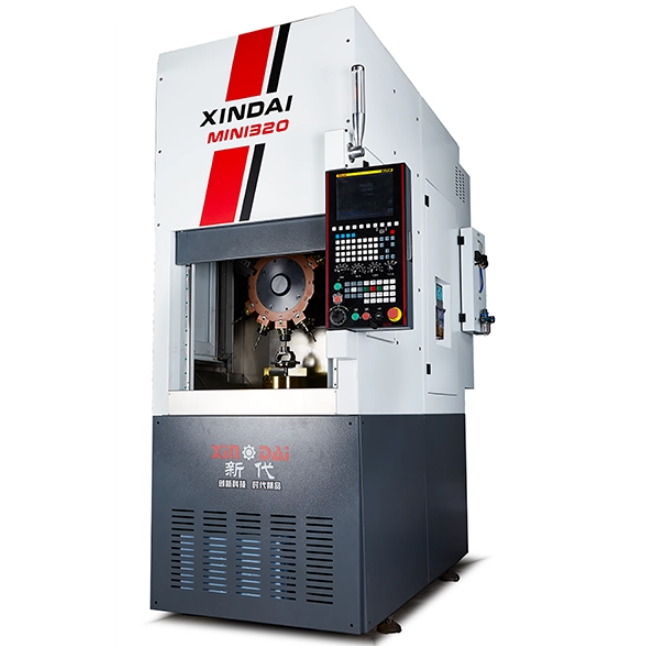
When dealing with large, heavy, and often asymmetrical workpieces like large gear blanks, railway wheels, or valve bodies, a standard horizontal lathe struggles. Loading these parts is difficult and unsafe. This is where a Vertical Turning Lathe (VTL) excels. In a VTL, the chuck is horizontal, like a turntable. The heavy workpiece is placed on top of it, allowing gravity to assist in securing it. The tool turret moves vertically and horizontally to perform the machining operations. For massive parts, VTLs are the safer and more rigid solution. Examining CNC turning center technical specifications for VTLs reveals a focus on high torque and extreme rigidity to handle these demanding applications.
In the age of Industry 4.0, a machine's ability to integrate with automation is a key future-proofing feature. When selecting a machine, evaluate its automation readiness:
Controller APIs: Does the CNC controller have an open Application Programming Interface (API) that allows for easy communication with robotic loaders (cobots), gantry systems, and centralized monitoring software?
Physical Footprint: Is there adequate physical space around the machine door for a robot to operate without obstruction? Does the machine design facilitate automatic door opening and closing?
Peripheral Integration: Does the machine seamlessly synchronize with peripherals like high-pressure coolant systems and automatic bar feeders?
The sticker price of a CNC machine is only one part of the total investment. A comprehensive Total Cost of Ownership (TCO) analysis considers long-term operational costs, including training, service, maintenance, and peripherals. These factors significantly impact the machine's ultimate return on investment (ROI).
The CNC controller is the brain of the machine. The choice between a standardized, widely used control and a proprietary system has long-term consequences.
Standardized Controls (Fanuc, Siemens, Mitsubishi): These systems have a large installed base, meaning there is a wide pool of trained operators and service technicians. Training new employees is easier, and finding third-party support is straightforward.
Proprietary Systems: While often powerful and feature-rich, these controls can lock you into a single manufacturer for service and parts. Training can be more intensive, and finding experienced operators may be more difficult.
The performance of a turning center is heavily influenced by its support systems. Skimping on these can lead to poor performance and chronic downtime.
For deep-hole drilling or machining materials that produce stringy chips (like stainless steel or titanium), standard flood coolant is insufficient. A high-pressure coolant system, typically delivering 70-80 bar (1,000+ PSI), is necessary to forcefully flush chips out of the cutting zone. This prevents chip recutting, reduces tool wear, and enables higher machining parameters.
Inefficient chip removal can halt production. The type of chip conveyor must match the materials you cut:
Hinge Belt Conveyors: Best for heavy, stringy, or bushy chips produced by steels and some alloys.
Scraper Conveyors: Ideal for fine chips and fines produced by cast iron or brass.
Downtime is the enemy of profitability. Industry data consistently shows that a significant portion of machine downtime is not caused by major mechanical failures but by smaller, often preventable issues. Studies indicate that up to 30% of unplanned downtime can be traced back to failures in the electrical or lubrication systems. Therefore, evaluating a machine's design for serviceability—easy access to lubrication points, well-organized electrical cabinets, and clear diagnostic information—is a critical part of the TCO calculation.
The best machine in the world is a poor investment if it is not backed by a reliable supplier. The final stage of your selection process should focus on mitigating risk by thoroughly vetting the vendor who will be your long-term partner.
Ask potential suppliers about their ratio of field service technicians to salespeople in your region. A company that invests heavily in its support infrastructure is more likely to provide prompt and effective service when you need it most. Check their local spare parts inventory. Waiting weeks for a critical component to be shipped from overseas can be devastating to your production schedule.
Never buy a significant piece of capital equipment based on a brochure or a demo of a simple part. The ultimate proof of a machine's capability is a pre-purchase run-off. This involves providing the supplier with a model of one of your most challenging parts and having them machine it on the exact model you intend to buy. A "guaranteed cycle time" commitment based on this real-world test provides a concrete performance baseline and holds the supplier accountable for their claims.
The investment doesn't end when the machine is delivered. Be sure to account for several hidden costs:
Foundation Requirements: High-precision machines often require a specific thickness and quality of reinforced concrete foundation to ensure stability and accuracy.
Power Conditioning: Your facility's electrical supply might not be "clean" enough for sensitive CNC electronics. A power conditioner or transformer may be required to prevent electrical issues.
Operator Training Curves: Factor in the time it will take for your team to become proficient on the new machine and control system. This learning curve represents a period of lower initial productivity.
Selecting the right CNC turning center is a strategic decision that reverberates through every aspect of your business. By shifting from a spec-sheet comparison to a "Part-First" evaluation logic, you align your investment directly with your production needs. This approach ensures you acquire a machine that not only meets today's requirements but also provides the capability to grow. Before making a final decision, run through this final checklist: confirm the capacity envelope, match the spindle and torque to your materials, select the right axis configuration for your part complexity, and verify the strength of the supplier's support network. Ultimately, the most expensive machine is not the one with the highest price tag, but the one that sits idle due to a misalignment between its capabilities and your work.
A: A traditional CNC lathe is typically a simpler, 2-axis machine for basic turning operations. A CNC turning center is a more advanced machine that usually includes a full enclosure, an automatic tool changer (turret), and often has additional capabilities like live tooling (milling, drilling) and sub-spindles. Essentially, a turning center is a lathe with enhanced functionality and automation features.
A: You should choose a machine with a Y-axis when your parts require off-center features like milled flats, drilled cross-holes, or complex keyways. While some of these can be approximated with C-axis interpolation on a standard live-tooling lathe, a true Y-axis provides far greater accuracy, better surface finishes, and the ability to machine true geometric shapes without compromise. It's essential for reducing secondary operations on a milling machine.
A: The spindle bore size dictates the maximum diameter of bar stock you can feed through the machine for automated production. Choosing a machine with a larger spindle bore than you currently need provides flexibility. It allows you to bid on future jobs that may require larger raw material, ensuring your machine does not become a limiting factor as your business grows and takes on more diverse work.
A: A power turret requires regular maintenance to ensure its longevity and accuracy. Key tasks include periodically checking and replenishing the gear lubrication, verifying the alignment of the live tool holders to prevent runout, and ensuring the coolant system for the live tools is functioning correctly to prevent overheating. Regular inspection of the drive mechanism and seals is also crucial to prevent contamination.


